 Dynafiber
As data-center networks expand, buyers need optical links that balance speed, reach, and operating cost. Cisco’s Annual Internet Report (2018–2023) projected global IP traffic would reach 396 exabytes per month by 2022. This was a forecast, not a measurement of 25GbE demand. Still, it shows the broader pressure on network capacity. A 25G SFP28 transceiver supports 25-gigabit Ethernet links in a compact form factor. IEEE 802.3by provides the relevant 25GbE standard. But matching the standard is only the beginning.
Choosing among the best 25G SFP28 transceiver suppliers in China requires more than comparing prices. Buyers should check wavelength, fiber type, reach, power consumption, temperature range, and host-device compatibility. Ask for test reports, warranty terms, and clear evidence of quality controls. A module that works in one switch may not work in another. Details matter. This guide will help compare supplier capabilities, product ranges, customization, and after-sales support. It will also distinguish documented specifications from sales claims. No supplier is perfect. Even a careful shortlist can miss compatibility issues that appear only during installation. Verify samples in your own equipment before placing a large order.
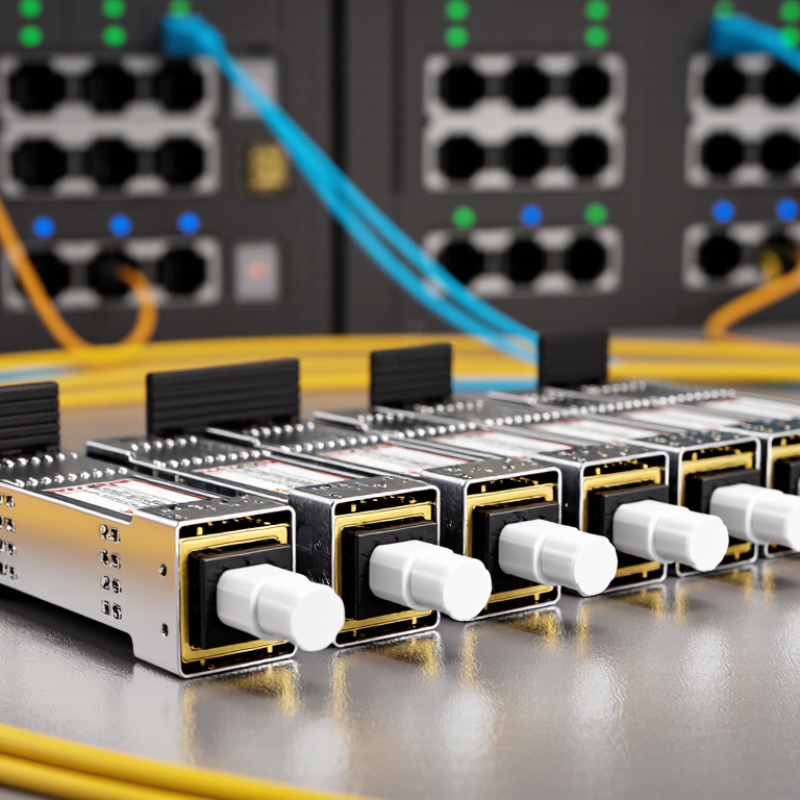
A 25G SFP28 transceiver is a compact optical module that connects a network switch or server to fiber cabling at 25 gigabits per second. Its small size helps dense racks carry more links without taking up extra front-panel space. Small, but useful. Different optics support different wavelengths, fiber types, and reach, so the module must match the cable and equipment at both ends.
In data centers, SFP28 links commonly connect servers to top-of-rack switches or link switches within a leaf-spine network. Short-reach multimode optics suit many connections within a room, while single-mode optics can support longer runs. Actual reach depends on the specific module, fiber quality, and link budget. Check the equipment’s supported interface, optical specifications, and diagnostic monitoring before installation. A link light alone does not confirm that performance is healthy.
On site, technicians often compare module labels, inspect fiber connectors, and check received optical power when a link behaves unexpectedly. Dust on a connector can cause trouble, even when every specification appears correct. One detail is easy to overlook: compatibility information may not explain every firmware or temperature limitation. I would verify those points with the equipment documentation and test a sample link before a larger rollout. That extra step takes time, but it can prevent avoidable interruptions.
A practical comparison of common 25G SFP28 connectivity options and the supplier checks that help buyers assess compatibility, quality, and application fit. This is a product guide, not a ranking of suppliers.
| Product Type | Optical / Cable Interface | Typical Reach | Common Applications | Supplier Details to Verify |
|---|---|---|---|---|
| 25GBASE-SR SFP28 | 850 nm; multimode fiber; duplex LC | Up to 70 m over OM3 or 100 m over OM4, subject to the specified link and cabling conditions | Short-reach links within data centers, including server-to-switch and switch-to-switch connections | Confirm the supported fiber grade, connector type, optical budget, DOM/DDM support, and host-device compatibility. |
| 25GBASE-LR SFP28 | 1310 nm; single-mode fiber; duplex LC | Up to 10 km on suitable single-mode fiber | Longer data-center links, campus networks, and connections between network rooms or buildings | Check the stated reach and optical specifications, required fiber type, transmitter/receiver limits, and interoperability requirements. |
| 25G BiDi SFP28 | Single-mode fiber; one strand; wavelength pair depends on the module | Commonly offered for links up to 10 km; the exact reach is product-specific | Links where fiber strands are limited and an existing single-fiber path is available | Verify that the two endpoints use complementary wavelengths and are sold or specified as a matched pair; confirm reach and connector details. |
| 25GBASE-CR SFP28 DAC | Direct-attach twinax copper cable with SFP28 ends | Short rack-scale connections; available cable lengths vary by design and host requirements | Top-of-rack connections between servers and switches, or between nearby switches | Ask for the exact cable length, passive or active design, supported data rate, host coding compatibility, and cable assembly test information. |
| 25G SFP28 AOC | Active optical cable with fixed optical ends | Product-dependent; commonly used for short-to-medium data-center links | Rack-to-rack or row-level links where a pre-terminated cable is preferred | Confirm available lengths, supported host platforms, power requirements, cable construction, and whether the assembly is tested as a complete link. |
| 25G SFP28 CWDM / other wavelength options | Single-mode fiber; wavelength and channel plan depend on the product | Reach varies by wavelength plan and module specification | Fiber-constrained links or deployments using a planned wavelength-division system | Request the exact wavelength, channel spacing, optical budget, required mux/demux equipment, and compatibility information for both link ends. |
| Supplier quality and compatibility review | Applies to optical modules, DACs, and AOCs | Not applicable | Procurement qualification, deployment planning, and ongoing network maintenance | Evaluate published datasheets, coding options, DOM/DDM support, warranty and return terms, traceability, sample testing, and written compatibility confirmation. |
Selection note: Reach figures are typical reference values, not a guarantee for every installation. Confirm the module datasheet, fiber quality, connector losses, host port support, and link budget before ordering. “SFP28” describes the form factor; it does not by itself guarantee that a module will interoperate with every switch or NIC.
Match its wavelength, fiber type, connector, reach, and link budget to your switches and cabling. Check the actual network setup. A datasheet alone is not enough.
A module may behave differently in a live host than on a bench. Test link stability, power draw, and error rates on your intended switches. Reboot the link several times, too.
Ask for transmit and receive measurements, diagnostic-monitoring checks, and serial-level traceability. Clear records make it easier to investigate a failed unit. Missing details deserve a closer look.
Confirm the supported media, wavelength, reach, and connector. A short-reach multimode module is not interchangeable with a long-reach single-mode option. Check the cable, not just the label.
Check the module’s temperature rating if it will sit in a warm cabinet. A few degrees can matter. Measure the environment where the equipment runs.
Ask for coding details and guidance for your exact switch configuration. Generic assurances do not resolve every host issue. Test before a larger order.
Compare realistic lead times, warranty terms, and the process for handling failed units. Technical replies should address your setup, not repeat broad claims. Support quality can be uneven.
No. Standards describe technical requirements, while forecasts estimate future demand. Neither proves a module will work reliably in your network. Current test results matter more.
Choosing the right 25G SFP28 transceiver supplier in China begins with understanding how these modules support high-speed data connections in applications such as data centers, enterprise networks, and telecommunications infrastructure. Buyers should consider the required reach, fiber type, wavelength, power consumption, operating conditions, and compatibility with their existing equipment. Clear product specifications and reliable testing information can help determine whether a module suits a particular network.
When comparing suppliers, assess product range, quality control, customization options, delivery capabilities, warranty terms, and technical support. Compatibility should be verified for the intended switches, routers, and network configuration rather than assumed from a general product description. The best supplier is not necessarily the one with the lowest price; it is the one that offers a dependable balance of performance, cost, availability, and support. By defining network requirements first and carefully comparing suppliers against them, organizations can make a more informed purchasing decision.
